.png)
Ohio Blocks Funding For Trans-Affirming Mental Health Care For Youth And Adults
Governor Mike DeWine vetoed some anti-trans measures of the state budget bill, but signed off on others. The fight still isn’t over.

On June 30, 45 minutes before his midnight deadline, Ohio’s Republican Governor Mike DeWine signed off on a sweeping budget bill. Tucked between thousands of pages of fiscal items and expenditures is a jarring declaration: Trans-affirming mental health providers have been explicitly cut off from Medicaid funds, impacting both minor and adult patients.
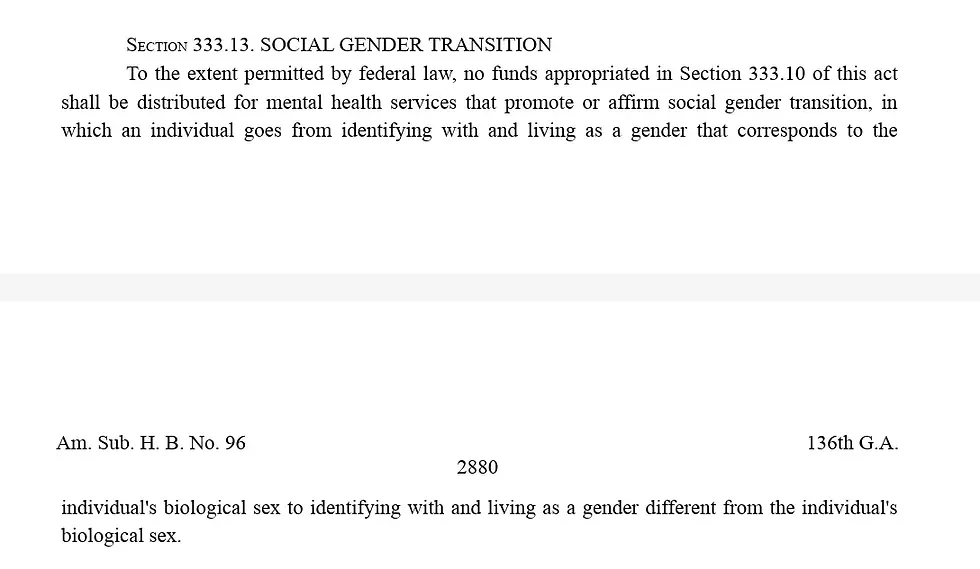
Prior state laws had outlawed Medicaid funds for “gender transition” treatment, which includes “including social, legal, or physical changes.” But in 2019, The Washington Post reported that Ohio officials were “no longer following policies that exclude those services,” and in 2024, the state’s HB 68 made it so that “assistance provided under the medicaid program shall not include coverage for gender transition services” for minors.
This new policy doubles down in explicitly articulating that mental health care is subjected to this rule and that it extends not just to minors, but also adults. It is not a categorical health care ban, as private insurers may still cover such care, and there are out-of-pocket options. But it does make care profoundly more difficult to access, especially for low income Ohioans, and even more, it stokes terror among health care providers.
Like many state laws around the country, the rule creates a vast and vague grey area both legally and medically. The recent budget item, for example, “does not outline clear modes for enforcement in any way,” said Dara Adkison, TransOhio’s executive director, in an interview with Erin in the Morning. “And how could it? It's written in fiscal policy.”
This leaves enforcement “nefariously up in the air,” they said, and this is intentional. One might argue the uncertainty is the enforcement measure—it can cause some providers to comply in advance or over-comply in order to skirt a potential legal battle. The state doesn’t even have to bring charges to get some health care systems to close their doors, such as in California, where the Children’s Hospital Los Angeles shuttered its division for trans youth care despite state protections for it.
The Medicaid ban is not the only anti-trans item in Ohio’s budget bill. “It is the policy of the state of Ohio to recognize two sexes, male and female,” the bill declares, enshrining a patently unscientific and ideologically-driven definition of sex into law. In reality, there are a wide range of biological sexes encompassing many combinations of chromosomes, internal genitalia, external genitalia, and secondary sex characteristics—such as breast tissue or facial hair.
The policy functionally rewrites any aspect of state code that touches upon gender or sex, similar to President Donald Trump’s executive order in the same vein, and erases the existence of at least 5.6 million intersex Americans. It throws countless trans Ohioans’ state identification into possible disarray in the process. The bill also bans the government from putting menstrual products in the men’s room of a public building.
Like the Medicaid ban, enforcement mechanisms for these mandates remain unclear.
State-level tensions have soared since the Supreme Court ruled in favor of anti-trans policies in its U.S. v Skrmetti decision. According to Ryan Thoreson, an assistant professor of law at the University of Cincinnati, however, Skrmetti does not constitute the carte blanche destruction of trans people’s legal rights. There are still other battles to be fought. “Skrmetti has to do with a very particular interpretation of the federal Constitution and doesn't necessarily decide state law claims that might be brought across the U.S., particularly those states with stronger equal protections provisions,” Thoreson told Erin in the Morning.
For example, Ohioans benefit from a right to choose their health care in their state constitution; this can be an avenue for challenging the Medicaid policy. Similarly, Montana courts have overturned numerous statewide anti-trans laws on account of the Montana constitution’s right to privacy.
Meanwhile, Medicaid restrictions are also being debated at the federal level. While the Senate Parliamentarian did determine that GOP’s anti-trans, Hyde Amendment-like provision was not germane to the budget bill, the document is now in the House. It accompanies a slew of harmful policies pertaining to everything from mass deportations to cuts to food stamps.
Pressure must still be added to those legislators to keep the federal trans care Medicaid ban at bay, and even more, to vote “no” on the bill altogether.
“Anything to mitigate the harm of cutting money from Medicaid, federally, is going to help at the state level,” Adkison said. “If the funds are significantly chopped at the federal level and the funds don't even exist for the coverage, even if the coverage is possible, that's a whole other issue.”
Back in Ohio, the passage of the budget bill was, to some level, bittersweet. In Governor Mike DeWine’s record-breaking list of vetoes, he struck down policies designed to ban Pride flag displays on state grounds, heavily censor LGBT content in libraries, and defund trans-affirming youth homeless shelters. But pressure points remain there as well. The state legislature can still override DeWine’s vetoes until December 31, 2026, and they have done so successfully in the past to advance anti-LGBT policies.
Other states are taking a proactive approach to beat Trump to the punch. Massachusetts, for example, is on track to allot one million dollars to an Affirming Health Care Trust, relegating funds to gender-affirming care for trans people. This ensures access even if the federal government does not financially support it. Existing state law further reaffirms that “access to reproductive health care services and gender-affirming health care services is a right” and that “interference with this right, whether or not under the color of law” is prohibited.
Individual cities may be able to take action, too—the Democratic nominee for New York City Mayor, Assemblyman Zohran Mamdani, has promised $65 million in city funds to support trans-affirming care, if he is elected.
(c) 2025, Erin In The Morning


It's disheartening to see Ohio block funding for trans-affirming care; this impacts mental health profoundly! We should push for resources that foster inclusivity. Just like those engaging browser games, we need spaces where everyone feels safe and valued.
Las herramientas para trabajar con texto pueden resultar útiles en muchas actividades digitales. Text Tools permite contar con recursos que ayudan a modificar, organizar o revisar contenido de forma más rápida. Son especialmente prácticas cuando se realizan tareas repetitivas y se necesita ahorrar tiempo durante la edición.
Thank you for shedding light on such an important issue! It’s disheartening to see funding blocked for essential trans-affirming care. cookie clicker 2 Your insights really highlight the urgent need for support in our communities.
Car Games deliver fast-paced racing action, realistic driving experiences, and endless excitement for players of all ages.
Thank you for shedding light on such a critical issue. Slope Blocking funding for trans-affirming mental health care reflects broader societal challenges that impact not just Ohio, but our entire commitment to inclusivity and support for vulnerable communities. Your insights are invaluable in advocating for change.